



Discover Roatan Communities
February 11, 2023Your First Scuba Dive in Roatan: What to Expect Underwater
Curious about scuba diving, but not sure what it feels like to breathe underwater? You’re not alone. For many people, the idea of exploring a coral reef is exciting, but taking that first breath beneath the surface can seem a little intimidating.
The good news is that you don’t need a diving certification or previous experience to give it a try.
With a Discover Scuba Diving experience, you can learn the basics, become familiar with the equipment, practice in shallow water and eventually explore a real Caribbean reef with an instructor by your side.
At Scuba Nomad Roatan, we believe your first dive should be more than a quick underwater tour. It’s an opportunity to discover a completely new environment, learn something about yourself and experience the underwater world at your own pace.
Your First Breath Underwater: An Unusual Feeling
Let’s start with something that might surprise you: breathing underwater can feel strange at first.
Our brains are accustomed to associating being underwater with holding our breath. Suddenly being able to breathe through a regulator feels unfamiliar.
Some people adapt almost immediately. Others need a little more time.
And that’s completely normal.
If you feel nervous during your first attempts, you can simply lift your face out of the water, take a moment and try again when you’re ready.
We encourage slow, relaxed breathing and give you time to find a comfortable rhythm. There’s no need to rush through this part.
One of the most rewarding moments is watching someone who was initially hesitant begin to relax and realize that breathing underwater really works!
Before Getting Wet: Let’s Talk About Diving
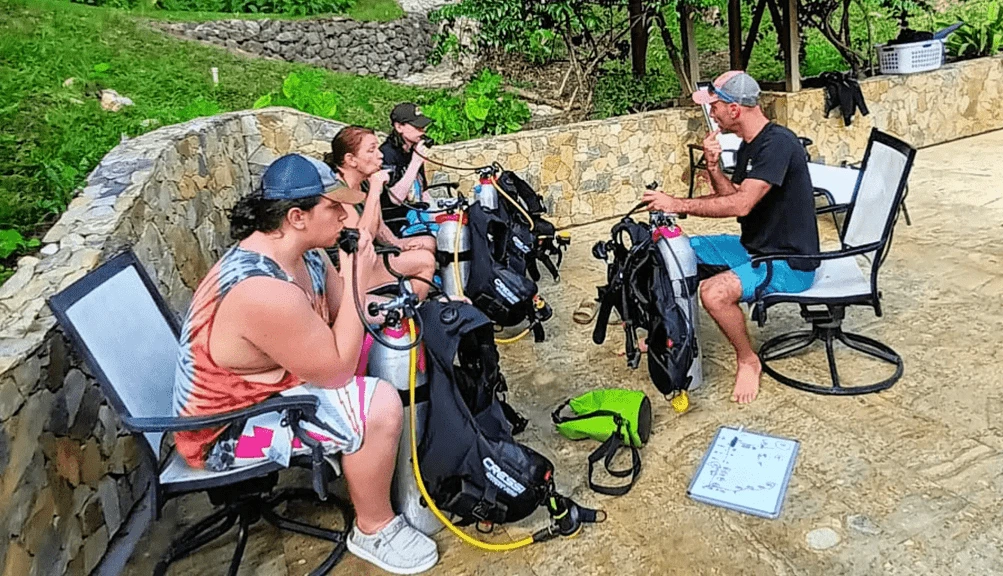
Your Discover Scuba Diving experience begins on land with a short introduction to the basic principles of scuba diving.
But don’t expect a long classroom lecture.
We normally spend around 30 minutes talking through the essentials, using a whiteboard to help visualize the explanations. It’s an interactive conversation, and questions are always welcome.
We want you to understand what you’re going to do underwater, not simply memorize instructions.
Afterward, we introduce the diving equipment.
You’ll have the opportunity to touch it, see how everything works and get familiar with the different components before entering the pool.
In fact, you’ll take your very first breath through a scuba regulator while comfortably sitting on a chair.
It’s a simple step, but it helps make that first underwater breath feel much less unfamiliar.
Learning in the Pool: One Step at a Time
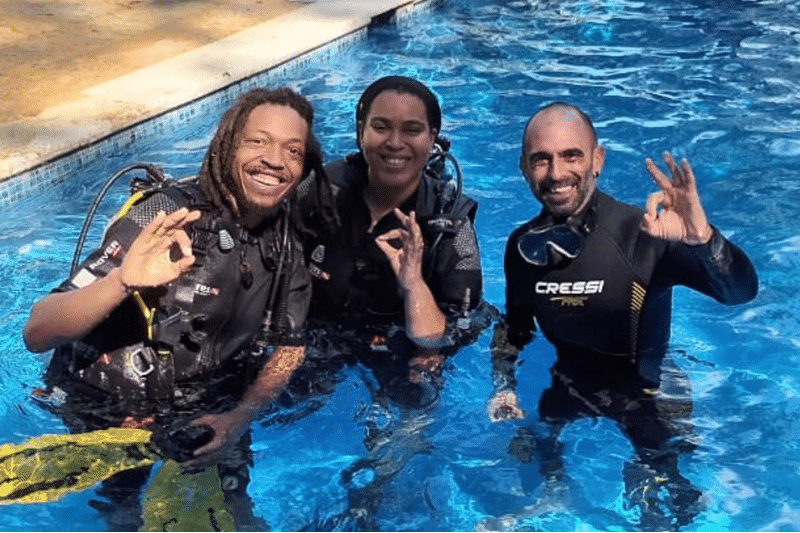
Once you’re comfortable with the equipment, we move into the pool.
We begin by floating at the surface with your equipment inflated. You can put your face in the water, look around, breathe through the regulator and experiment with the sensation of being supported by your scuba gear.
If you need a little extra time to get used to breathing underwater, this is the perfect moment.
When you’re ready, we gently descend into approximately four feet (1.2 metres) of water.
Yes, that’s all.
We’re still in a shallow area where you can stand up whenever you need a break.
Here, we practice a few essential diving skills, including clearing water from your regulator, recovering your regulator and clearing water from your mask.
For some beginners, mask clearing is the most challenging part. Having water around your nose while breathing through your mouth takes a little getting used to.
If you find it difficult, we break the exercise into smaller steps and practice progressively, starting from the surface if necessary.
There’s no competition and no pressure to get everything right on your first attempt.
More Than Just Being Guided Underwater
There’s another skill we particularly like to introduce during our Discover Scuba Diving experience: buoyancy control.
Buoyancy is what allows divers to float, descend, ascend and maintain a comfortable position underwater.
Of course, mastering buoyancy takes practice and experience. Nobody expects you to become an expert during your very first dive.
But we believe that even a basic introduction makes a big difference.
Whenever possible, we encourage you to participate actively in controlling your position in the water rather than simply allowing the instructor to manage every movement.
You’ll begin to discover how your breathing and equipment affect your buoyancy, always under our close supervision.
This changes the experience.
Instead of feeling like a passenger being taken underwater, you begin to understand what you’re doing and develop a sense of control.
For many beginners, that feeling of actually learning to dive makes the experience even more satisfying.
Your First Reef Dive: Welcome to a Different World
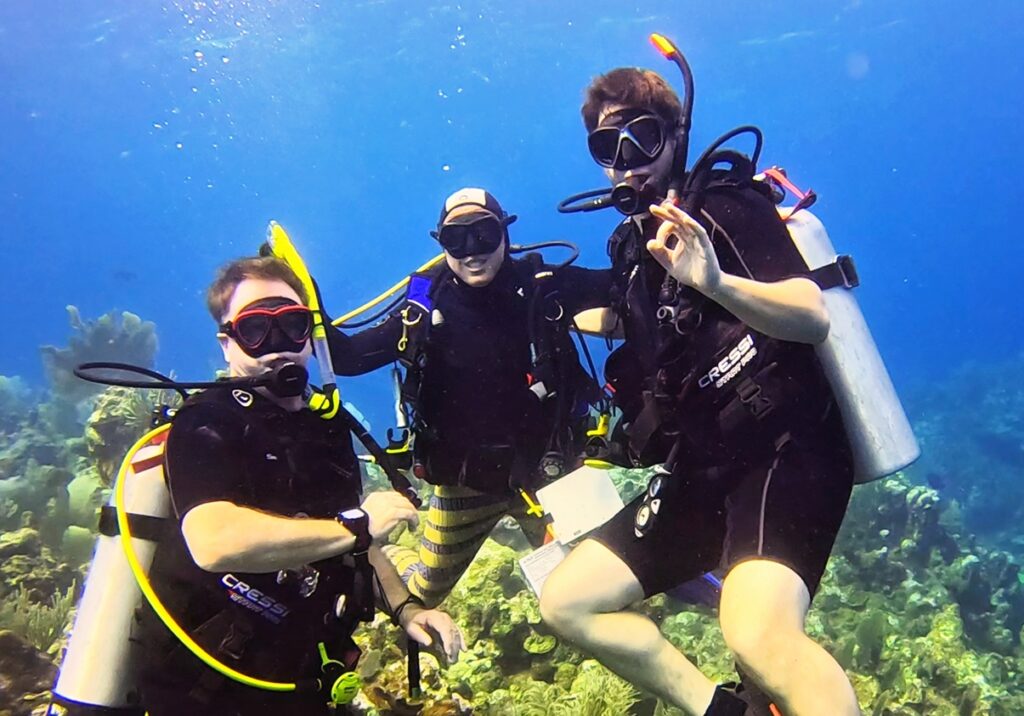
After the pool session, it’s time to explore the reef.
For your first ocean dive, we choose a shallow area with a sandy bottom surrounded by coral formations.
It’s a comfortable place to begin, allowing you to settle into the underwater environment before exploring further.
Your instructor stays close throughout the dive, helping with buoyancy, positioning or ear equalization whenever necessary.
We move slowly, giving you time to relax and enjoy what’s around you.
And there’s plenty to see.
Colorful parrotfish swim among the corals, damselfish move around their territories, and angelfish and butterflyfish explore the reef. Groupers and snappers are also common inhabitants of these waters.
Sometimes we encounter barracudas, sea turtles or rays.
But this is a natural reef, not an aquarium. Marine animals move freely, and every dive brings different encounters.
We often pause to observe an interesting coral formation, watch fish interacting or simply appreciate the incredible variety of life around us.
There’s no need to cover a long distance or reach a particular destination.
Your first dive is about enjoying the underwater world, not rushing through it.
From Nervous Beginners to Underwater Explorers
One of our favorite parts of teaching Discover Scuba Diving is seeing how people change throughout the experience.
Someone who initially struggled to put their face underwater may, a little later, be swimming calmly above the reef, watching fish and discovering a world they had only seen in photographs or documentaries.
It often takes a few minutes at the beginning of the ocean dive to become fully comfortable.
Then something changes.
People start looking around rather than concentrating only on their breathing. They begin noticing the corals, following the movements of fish and enjoying the sensation of being underwater.
And when we return to the surface?
We often hear things like:
“That was amazing!”
“Awesome!”
“It’s a completely different world!”
Of course, everyone’s experience is different. Sometimes a participant may decide that diving isn’t for them, and that’s a decision we always respect.
But helping someone move from uncertainty to confidence, and seeing their excitement afterward, is one of the most rewarding parts of our work.
Ready to Try Scuba Diving in Roatan?
You don’t need previous scuba experience to participate in our Discover Scuba Diving program.
At Scuba Nomad Roatan, the experience includes:
- An interactive introduction to scuba diving
- Familiarization with all the necessary equipment
- Supervised practice in the pool
- One guided dive on a beautiful Roatan coral reef
- All diving equipment, water and snacks
The complete activity takes approximately four hours, and the minimum participation age is 10 years.
During the reef dive, the maximum depth is 12 metres (40 feet), although the actual depth depends on your comfort and the conditions.
We also welcome people who are not confident swimmers, with individual supervision and an approach adapted to their needs.
Whether you’re visiting Roatan on vacation or stopping on the island during a cruise, we’ll help you understand what to expect and organize your experience.
Your first scuba dive might begin with a little uncertainty, but it could end with the discovery of an entirely new world.
Learn more about Discover Scuba Diving in Roatan
Scuba Nomad Roatan — Small groups, personal attention and a passion for exploring the underwater world.